
Pixel Art Tilesets
Tilesets turn a handful of squares into infinite worlds — provided every edge agrees with its neighbors.
Grid discipline first
Choose tile size (16 or 32 px) and never deviate: every tile is exactly that, drawn on the same grid with the same palette family. Work with a visible grid and whole-pixel coordinates only — a 1 px offset is a visible seam in-game. Keep a test map beside the tiles and eyeball repeats constantly.
Seamless edges, honestly earned
A tile is seamless when its left edge continues its right edge (and top continues bottom). Techniques: draw features that exit one side and re-enter the opposite; keep high-contrast details away from borders; mirror-test by tiling 3×3 and hunting the grid. Reserve edge pixels for transitions and interiors for character — the classic beginner error is centering every detail and starving the seams.
The minimal useful set
You need fewer tiles than you think: flat fill, edge, inner corner, outer corner per terrain, plus 2–3 decoration variants. Build the set on layers — base, edge transitions, details — so variants are recombinations, not redraws. Export individuals as PNG; engines assemble the sheet.
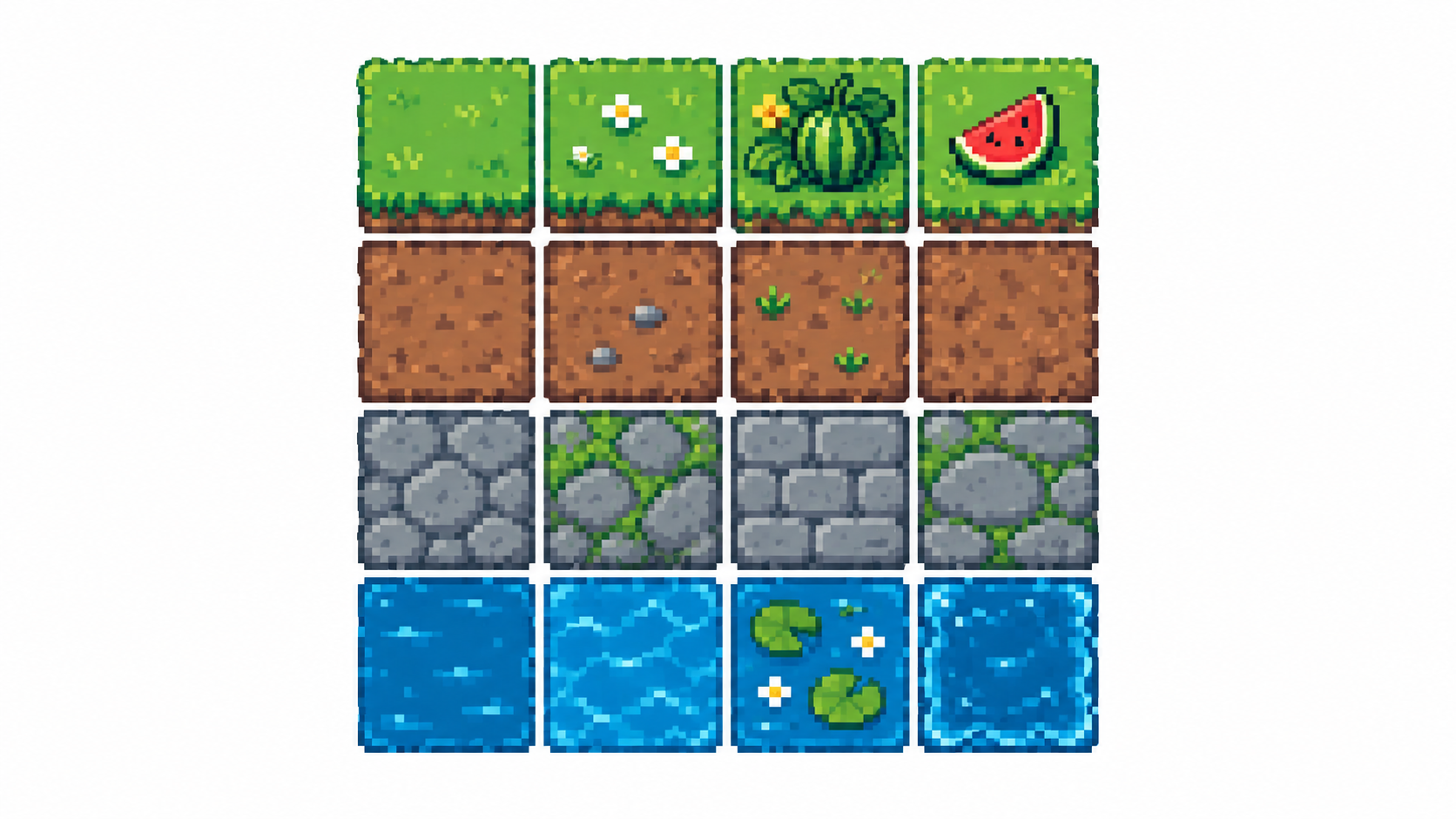
Tiles meet the world
Tiles must agree with sprites standing on them (shared palette, shared grid) and with backgrounds behind them (values stepped back). Test character-on-tile early: half of all tileset rework comes from that meeting looking wrong.
Frequently asked questions
What size should tiles be?
16 or 32 px, matching characters and grid. Exact, whole pixels, no exceptions.
How do I hide tile seams?
Continue features across opposite edges, keep contrast off borders, and mirror-test 3×3 while drawing.
How many tiles do I need?
Fewer than feared: fill, edge, both corners per terrain plus a couple of decorations — recombine via layers.
What is autotiling?
Some engines pick edge and corner pieces automatically from neighbors. Design the minimal set — fill, edge, both corners — so automation has clean pieces to choose.
Ready to draw? Open the Pixel Art Maker